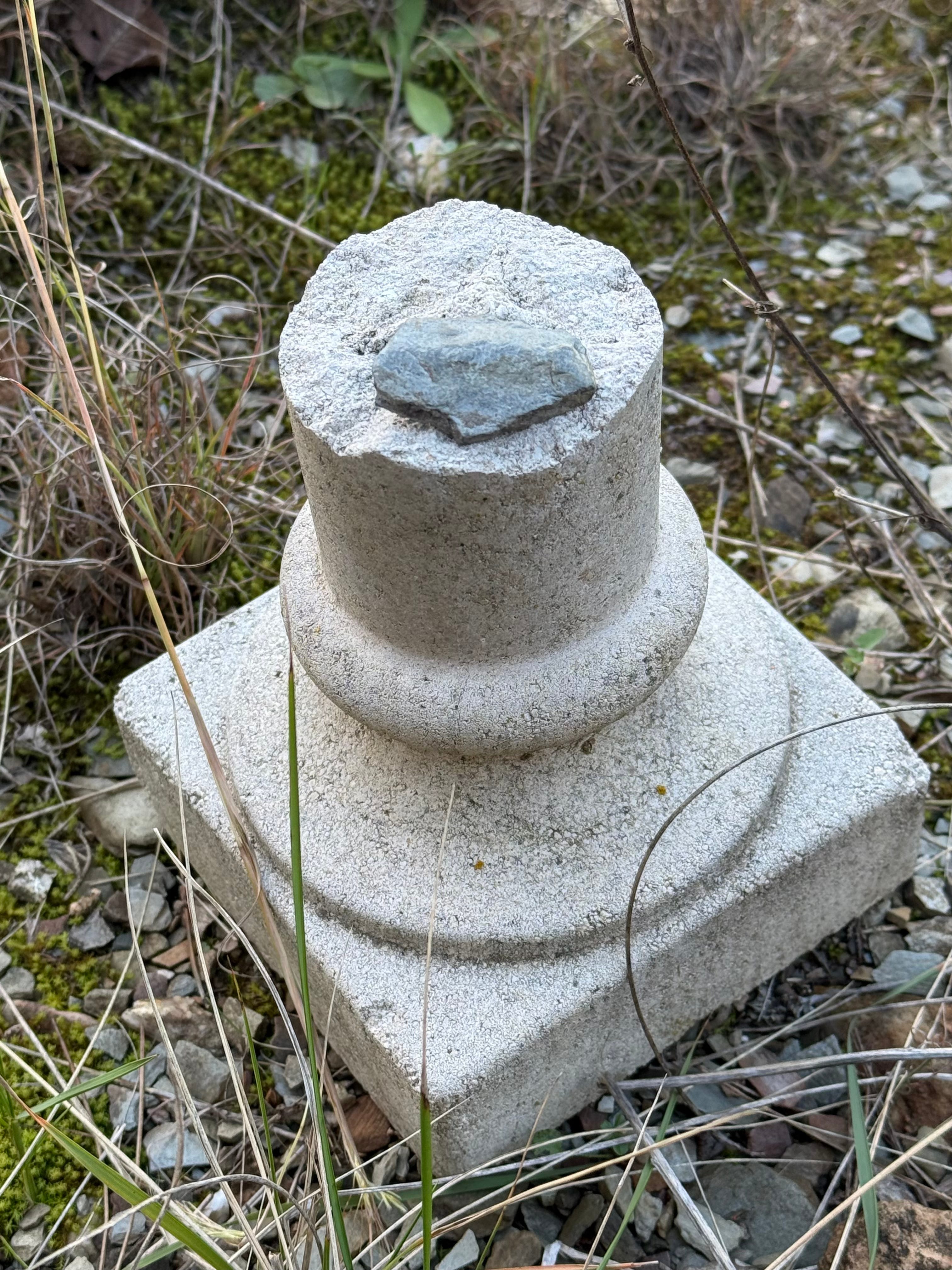
The Displaced Stone
Can Serrat, El Bruc

Why do we always want to possess things? Why do we first displace them, and then domesticate them?
A stone moved from the mountain. The living beings beneath it were left homeless. We took it and subjected it to various processes. Perhaps holding it made us feel safe; perhaps, at certain moments, it reminded us of something. (My therapist once told me to choose an object and, when difficult memories surface, to look at it and hold it tightly.) Maybe we displaced it to feel better, maybe simply to turn it into a keepsake. Now each of us has a stone. Its original place, however, remains empty. The creatures and plants that once settled beneath it have long since begun searching for new homes. Or perhaps those empty places will be filled again over time—by rainwater, by sediment, by a human step.
For now, the stones are with us. In front of us, resting on a pedestal. How the pedestal arrived here is unknown, but it, too, has become part of the landscape. The stone settled onto it. The grasses around it slowly wrapped themselves around its base. It adapted to this new space. Yet, on such a monumental pedestal, it will not be left in peace by what surrounds it. We displaced it. In doing so, perhaps we did something good for it—perhaps we did not. We will never know. The language of the non-human cannot be spoken. Adapting to a new place takes time.
Where do we find this courage to dominate? Where does this power come from? By what right do we attempt to own everything? Perhaps the stone is far from where it belongs, perhaps it is content—but it is where we want it to be. How do we claim the authority to design living spaces? What if nature were to decide for our lives, or rule over us? We changed that too. Through intervention, we changed everything.
The stone is no longer simply a stone. On an artificial pedestal, it becomes an object foreign to its surroundings. It does not recognize the species of grass beside it; the grass does not recognize the stone. The pedestal is accustomed—it can carry every kind of burden. It is always temporary. The stone, too, will migrate again. Perhaps with a kick, perhaps carried in the pocket of someone like us, taken as a souvenir to another country. The stone will keep traveling. Or it may be born on a mountain and remain there until the end of its life. If no one intervenes, perhaps over time it will shrink, gather moss, or take root.
Roots. What does it mean to have roots? What does origin mean? We keep trying to root what we know through acts of domination. Yet there are also those who dominate us. We are all of the same species. Those who hold power can act cruelly toward others. I wonder—can a stone oppress another stone? Who are we? Who displaces us? The subjects change, but displacement does not. The displaced and the displacer are one and the same. We are the ones who construct all of this. We are all standing on a pedestal we do not know, tiny fragments within a landscape.